
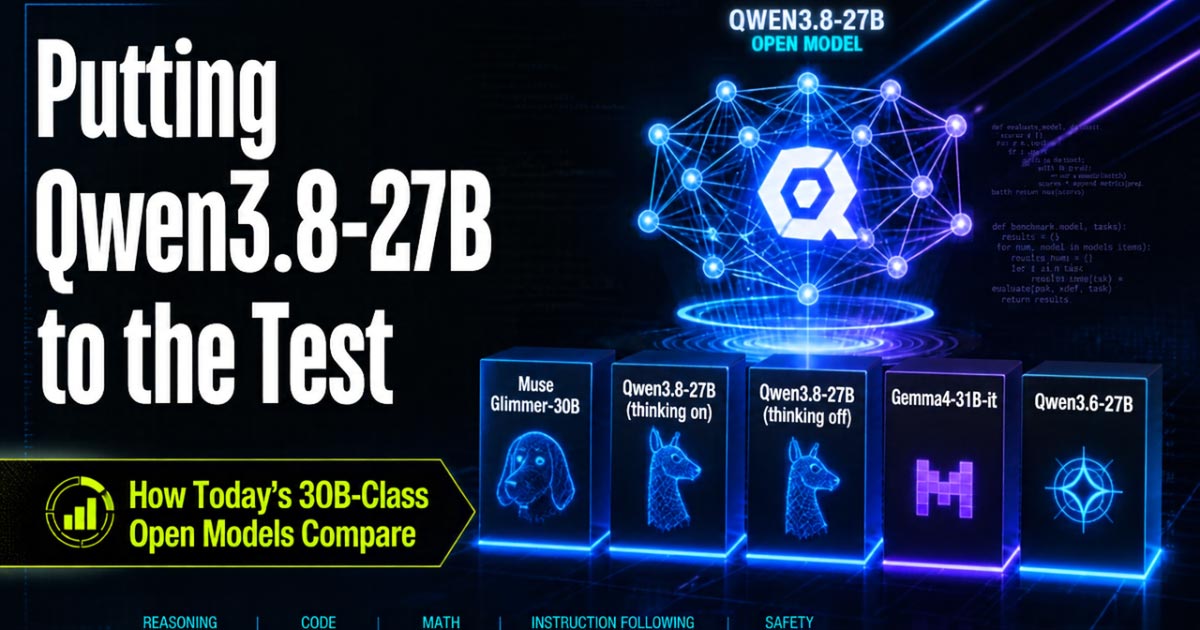
Local LLMs are having a moment. Over the past few months, 30B-class open-weight models have been arriving one after another, and the reported results are impressive — a few of them are now matching paid APIs. Qwen3.8-27B is one of the models at the center of that buzz.
So, as in our previous post, we spun up an A100 80GB on Hypha and put Qwen3.8-27B through its paces. The question wasn’t “how high does it score on a benchmark?” but “could an engineer actually use this at work tomorrow?” To find out, we compared it with three other 30B-class models on a job we all face constantly: making sense of a brand-new AI release.
1. Qwen3.8-27B
Qwen3.8-27B is an open-weight model developed by Alibaba in China and released on August 15, 2026.
It has quickly become one of the most talked-about open models on social media, and the published benchmark scores back that up: they hold up well against other models of the same size and even against closed models such as Opus 4.6 Max. The Qwen family is also the base model with the most derivatives on Hugging Face. When people say “open weights” these days, Qwen is usually the first name that comes up.

2. Contenders

Qwen3.6-27B
Qwen3.6-27B is the direct predecessor of Qwen3.8-27B, released on April 22, 2026.
It is a popular and capable open-weight model in its own right. Including it lets us measure how much ground Qwen gained in a single generation.
Muse Glimmer-30B
Muse Glimmer-30B is Meta’s model, released on August 10, 2026.
Meta is best known for the Llama series, but it had gone a long time without an open-weight release. We wanted to see how its new model stacks up against Qwen.
Gemma4-31B-it
Gemma4-31B is Google’s model, released on March 31, 2026.
Gemma has long been Google’s open-weight line and the model most often measured head-to-head against Qwen, so it was a natural inclusion.
3. The Task: Summarize and Explain a New Model

Our comparison task was summarization and explanation. Anyone working with AI has to keep up with a relentless stream of new releases, and an LLM that can digest a release into something usable saves real time. The question is whether a 30B-class model can do that job well enough to rely on.
Concretely, we asked each model to summarize and explain Ornith-1.5, a 35B-class model that happened to be released while this article was being written.
A local LLM can’t search the web on its own, so we fetched the content of the page below and handed it to each model as context.
Full disclosure: I didn’t know much about this model myself, which made it a good test. Could each model turn unfamiliar information into something an engineer could actually act on?
4. How We Evaluated

The single question was “which of these could I use at work?” We approached it from two angles with different levels of resolution:
- The author (macro): read each complete output and rank the models on overall impression, taking clarity, depth, and inference time into account.
- Grok 4.6 (micro): score each output on a five-point scale per criterion and rank by the results.
My own criteria were:
- Clarity and concision of the writing
- Specificity and depth of the numbers and technical detail
- Inference time
One human reviewer is bound to carry bias, so I added an LLM judge. Grok 4.6 rated each output from 1 to 5 on the following:
- Correctness: is the content accurate?
- Instruction Following: did it understand the request and its constraints?
- Clarity: is the explanation easy to follow?
- Practicality: could it be used as-is in real work?
- Human Effort: how much editing would a person need to do?
- Speed: inference speed
Any model larger and stronger than the 30B class would have done as a judge; I used Grok 4.6 through Cursor because it was convenient. The two evaluations work differently — gut-level judgment versus rubric scoring — so I didn’t expect the rankings to match one-to-one. As long as the top models broadly agree, the LLM judge does its job as a check on my own bias.
5. Environment and Script

The evaluation ran in the same project setup as the previous article. Here’s the script if you’d like to run it yourself:
import gc
import re
import ssl
import time
import urllib.error
import urllib.request
from pathlib import Path

import torch
from transformers import AutoModelForCausalLM, AutoModelForMultimodalLM, AutoTokenizer

MUSE_REASONING_STRENGTH = "low"
QWEN38_REASONING_EFFORT = "low"
_MUSE_USER_RE = re.compile(
    r"to=user\s*<\|message\|>(.*?)(?:<\|eot\|>|<\|eom\|>|<\|end_of_text\|>|$)",
    re.DOTALL,
)
_MUSE_MESSAGE_RE = re.compile(
    r"<\|message\|>(.*?)(?:<\|eot\|>|<\|eom\|>|<\|end_of_text\|>|$)",
    re.DOTALL,
)

MODEL_NAMES = [
    # "Qwen/Qwen3.8-27B",
    # "Qwen/Qwen3.6-27B",
    # "google/gemma-4-31B-it",
    "meta-models/Muse-Glimmer-30B",
]
OUTPUT_DIR = Path(__file__).resolve().parent
ARTICLE_URL = "https://ornith.ai/ornith_1_5.html"
ARTICLE_HTML_PATH = OUTPUT_DIR / "ornith_1_5.html"
MAX_NEW_TOKENS = 4096

PROMPT_TEMPLATE = """
次のHTML記事を読んだ。LLMに詳しくない現場の人(開発・企画・運用)が、これを読んで日々の業務になんらかの活用したいと考えている。日本語で解説してほしい。
わかりやすさと親切さが最優先。専門用語は出したらすぐ日常のたとえを付ける。結論を先に書く。
数字は正確に使うこと。必要なら図表を用いても良い。
出力ファイル名は {output_name}。完成したMarkdownだけを出力すること。

含めてほしいこと:
- 一言で何か、何がどのようにすごいのか?
- 誰が作ったか(記事から分かることだけ。分からなければ分からないと書く)
- 何が新しいか(たとえ付き。報酬の式や学習の仕組みも、現場向けに噛み砕いてよい)
- これらの情報から現場ではどのような活用方法が考えられるか?
- 課題となりそうな点や、注意点はなにか?

記事にない人名、所属、点数は足さない。
最後に参考URLを書くこと。

出典: https://ornith.ai/ornith_1_5.html

----- 記事HTMLここから -----
{article}
----- 記事HTMLここまで -----
""".strip()


def download_article_html() -> str:
    request = urllib.request.Request(
        ARTICLE_URL,
        headers={"User-Agent": "Mozilla/5.0"},
    )
    try:
        with urllib.request.urlopen(request, timeout=30) as resp:
            return resp.read().decode("utf-8")
    except (ssl.SSLError, urllib.error.URLError):
        # ornith.ai の証明書が切れている場合がある
        context = ssl._create_unverified_context()
        with urllib.request.urlopen(request, timeout=30, context=context) as resp:
            return resp.read().decode("utf-8")


def load_article_html() -> str:
    print(f"記事を取得: {ARTICLE_URL}")
    try:
        html = download_article_html()
        ARTICLE_HTML_PATH.write_text(html, encoding="utf-8")
        print(f"保存: {ARTICLE_HTML_PATH}")
        return html
    except Exception as exc:
        if ARTICLE_HTML_PATH.exists():
            print(f"取得失敗 ({exc})。ローカル {ARTICLE_HTML_PATH} を使う")
            return ARTICLE_HTML_PATH.read_text(encoding="utf-8")
        raise SystemExit(f"記事HTMLを取得できません: {ARTICLE_URL}\n{exc}") from exc


def html_content_for_prompt(html: str) -> str:
    """CSS/JSは記事本体ではないので除く。本文・数式・表・脚注は残す。"""
    html = re.sub(
        r"<script\b[^>]*>.*?</script>", "", html, flags=re.IGNORECASE | re.DOTALL
    )
    html = re.sub(
        r"<style\b[^>]*>.*?</style>", "", html, flags=re.IGNORECASE | re.DOTALL
    )
    return html.strip()


def build_prompt(output_name: str, article: str) -> str:
    # HTML内の { }(MathJax)を str.format が壊さないよう、置換だけ使う
    return PROMPT_TEMPLATE.replace("{output_name}", output_name).replace(
        "{article}", article
    )


def memory_gb() -> float:
    if not torch.cuda.is_available():
        return 0.0
    return torch.cuda.max_memory_allocated() / (1024**3)


def extract_markdown(text: str) -> str:
    """本文中の ``` コードブロックは触らず、文書全体を包む ```markdown だけ外す。"""
    text = text.strip()
    outer = re.match(r"```(?:markdown|md)\s*\n(.*)\n```\s*$", text, re.DOTALL)
    if outer:
        return outer.group(1).strip() + "\n"
    return text + "\n"


def output_path_for(model_name: str) -> Path:
    short_name = model_name.rsplit("/", 1)[-1]
    return OUTPUT_DIR / f"research_ornith_{short_name}.md"


def is_muse(model_name: str) -> bool:
    return "muse" in model_name.lower()


def is_qwen38(model_name: str) -> bool:
    return "qwen3.8" in model_name.lower()


def strip_qwen_thinking(text: str) -> str:
    """Qwen の思考ブロックを除く。開始 <think> は special token として消えることがある。"""
    text = re.sub(r"<think>.*?</think>", "", text, flags=re.DOTALL | re.IGNORECASE)
    if re.search(r"</think>", text, flags=re.IGNORECASE):
        text = re.split(r"</think>", text, maxsplit=1, flags=re.IGNORECASE)[-1]
    return text.strip()


def parse_muse_reply(text: str) -> str:
    user_match = _MUSE_USER_RE.search(text)
    if user_match:
        return user_match.group(1).strip()
    messages = _MUSE_MESSAGE_RE.findall(text)
    if messages:
        return messages[-1].strip()
    return text.strip()


def apply_chat_template(tokenizer, prompt: str, model_name: str) -> str:
    messages = [{"role": "user", "content": prompt}]
    kwargs = {
        "tokenize": False,
        "add_generation_prompt": True,
    }
    if is_qwen38(model_name):
        kwargs["enable_thinking"] = True
        kwargs["reasoning_effort"] = QWEN38_REASONING_EFFORT
    elif "qwen" in model_name.lower():
        kwargs["enable_thinking"] = False
    elif is_muse(model_name):
        kwargs["reasoning_strength"] = MUSE_REASONING_STRENGTH
    return tokenizer.apply_chat_template(messages, **kwargs)


def release_gpu(*objects) -> None:
    for obj in objects:
        del obj
    gc.collect()
    if torch.cuda.is_available():
        torch.cuda.empty_cache()
        torch.cuda.synchronize()


def run_one(model_name: str, article: str) -> None:
    output_path = output_path_for(model_name)
    prompt = build_prompt(output_path.name, article)

    print("=" * 60)
    print(f"モデル: {model_name}")
    print(f"出力: {output_path}")
    print("=" * 60)

    tokenizer = AutoTokenizer.from_pretrained(
        model_name,
        trust_remote_code=True,
    )
    model_cls = (
        AutoModelForMultimodalLM if is_muse(model_name) else AutoModelForCausalLM
    )
    model = model_cls.from_pretrained(
        model_name,
        dtype=torch.bfloat16,
        device_map="auto",
        trust_remote_code=True,
    )
    model.eval()

    text = apply_chat_template(tokenizer, prompt, model_name)
    device = next(model.parameters()).device
    inputs = tokenizer(text, return_tensors="pt").to(device)
    prompt_tokens = inputs["input_ids"].shape[1]

    if torch.cuda.is_available():
        torch.cuda.reset_peak_memory_stats()
        torch.cuda.synchronize()

    generate_kwargs = {
        "max_new_tokens": MAX_NEW_TOKENS,
        "do_sample": False,
    }
    if is_muse(model_name):
        generate_kwargs.update(
            do_sample=False,
        )

    start = time.perf_counter()
    with torch.no_grad():
        outputs = model.generate(**inputs, **generate_kwargs)
    if torch.cuda.is_available():
        torch.cuda.synchronize()
    elapsed = time.perf_counter() - start

    generated = outputs[0][prompt_tokens:]
    num_tokens = len(generated)
    if is_muse(model_name):
        raw = tokenizer.decode(generated, skip_special_tokens=False)
        reply = parse_muse_reply(raw)
    else:
        reply = tokenizer.decode(generated, skip_special_tokens=True)
        if is_qwen38(model_name):
            reply = strip_qwen_thinking(reply)
    markdown = extract_markdown(reply)
    output_path.write_text(markdown, encoding="utf-8")

    print(markdown, end="")
    print()
    print(f"生成Markdown: {output_path.resolve()}")
    print(f"トークン数: {num_tokens}")
    print(f"推論時間: {elapsed:.2f}s")
    print(f"推論速度: {num_tokens / elapsed:.1f} t/s")
    if torch.cuda.is_available():
        print(f"最大 GPU メモリ使用量: {memory_gb():.2f} GiB")
    print()

    release_gpu(model, tokenizer, inputs, outputs)


def main():
    article = html_content_for_prompt(load_article_html())
    print(f"記事HTML: {ARTICLE_HTML_PATH} ({len(article):,} 文字)")
    for model_name in MODEL_NAMES:
        run_one(model_name, article)


if __name__ == "__main__":
    print(f"CUDA available: {torch.cuda.is_available()}")
    if torch.cuda.is_available():
        print("CUDA を使用して推論を実行します。")
        print(f"GPU: {torch.cuda.get_device_name(0)}")
    if not torch.cuda.is_available():
        raise SystemExit("CUDA が使えないため推論を中止します。")
    main()
The inference mechanics are the same as last time, so I’ll skip those and just cover the prompt design:
- Prioritize clarity and helpfulness so that even readers without LLM expertise can follow along.
- Make the model aware that the user is a hands-on practitioner asking in order to apply the information at work.
- Fetch the article body with urllib.request and insert it into the prompt.
Each model exposes different arguments, so the conditions couldn’t be perfectly identical, but we got as close as possible:
- Qwen3.6-27B and Gemma4-31B-it: enable_thinking=False (thinking mode off). Muse Glimmer-30B can’t disable reasoning entirely, so we set reasoning_strength=”low”.
- Qwen3.8-27B can both switch thinking off and dial reasoning up or down like Muse Glimmer, so it alone got two configurations: enable_thinking=False, and enable_thinking=True with reasoning_effort=”low”.
- do_sample=False for every model, favoring accuracy over creativity.
6. Results

The full output from each model is attached:
- Output of Qwen3.8-27B (thinking mode ON)
- Output of Qwen3.8-27B (thinking mode OFF)
- Output of Muse Glimmer-30B
- Output of Gemma4-31B-it
- Output of Qwen3.6-27B
Inference time, token count, and throughput came out as follows:
| Model | Inference time (sec) | Tokens | Speed (tokens/sec) |
|---|---|---|---|
| Qwen3.8-27B (thinking off) | 142.81 | 1883 | 13.2 |
| Qwen3.8-27B (thinking on) | 255.35 | 3254 | 12.7 |
| Qwen3.6-27B | 177.67 | 2306 | 13.0 |
| Muse Glimmer-30B | 114.50 | 1888 | 16.5 |
| Gemma4-31B-it | 118.01 | 1105 | 9.4 |
Muse Glimmer-30B was the fastest of the group — a little surprising, given that it is larger than the two 27B Qwen models. Qwen3.8-27B in thinking mode produced far more tokens than in non-thinking mode, which confirms it was reasoning; what stands out is that Muse Glimmer, also reasoning, kept its token count modest. Gemma4 generated by far the fewest tokens and had the slowest throughput.
With these outputs and numbers in hand, both the author and the LLM judge weighed in.
7. The Verdict

7.1 The author’s take
With my own preferences and biases fully admitted, here is my ranking:
- Muse Glimmer-30B
- Qwen3.8-27B (thinking on)
- Qwen3.8-27B (thinking off)
- Gemma4-31B-it
- Qwen3.6-27B
I’d draw the line for “usable at work” after third place.
Overall, every model understood the material reasonably well, and all of them wrote fluent, natural Japanese. What surprised me was how much quality varied between models of roughly the same size. Qwen3.8 is the one making headlines, but Muse Glimmer impressed me just as much.
Here’s how each one came across.
Muse Glimmer-30B
Its biggest strength was how it handled equations. As an engineer, what I want from a model write-up is the mechanism — the technique that gets around the problem — so I can think about applying it myself, and clear mathematical notation with explanation makes that much easier. The analogies were apt, and it used technical terms rather than avoiding them, explaining what each one meant. (Analogies that ramble or contort themselves to dodge jargon are a pet peeve of mine.) The writing was concise throughout. This is a report I would actually use. On top of that, it was the fastest of all five configurations despite running in reasoning mode, which makes it an easy model to work with day to day.
Qwen3.8-27B (thinking on)
The richest content of the bunch. It used tables to organize key points more than any other model, and it gave the impression of having researched widely and organized carefully — comparing thinking mode to thinking mode, I’d put it ahead of Muse Glimmer on thoroughness. The weaknesses: it didn’t dig as deep into numbers and technical specifics, and its analogies ran long and didn’t land cleanly in Japanese. Those traits seem to run across the Qwen family. The other concern is time: far longer than Muse Glimmer in the same mode. Thinking hard does produce better answers, but on the job you often just want the key points quickly.
Qwen3.8-27B (thinking off)
Its sections on how to apply the model at work and on likely issues and caveats were the best organized of any model, which is a real plus. It also used tables, and it struck a nice balance between simplicity and structure, if not quite at the level of thinking mode. The analogies were a touch harder to follow than in thinking mode, and the inference time was long for a non-thinking run.
Gemma4-31B-it
The simplest and most concise of the five. Its tables around the equations were clear, and it correctly surfaced the specific figure of 20%. But it was too sparse — I wanted more depth and more data. As the largest model in the comparison, its slower speed is expected, but the low token count left me feeling it could have tried harder.
Qwen3.6-27B
Almost no numbers or equations, and an oddly detached, unconfident tone, as if describing something that had nothing to do with it. The analogies were hard to follow, especially its attempts to break down the math. Unfortunately, this is not a report I’d use. And since it’s no faster than Qwen3.8-27B, there’s no reason to pick 3.6. That makes the real takeaway clear: Qwen3.8 is a dramatic step up from its predecessor.
Now let’s look at Grok 4.6’s scores.
7.2 Grok 4.6’s evaluation
Grok 4.6’s full evaluation is attached:
| Rank | Author | Grok 4.6 |
|---|---|---|
| 1 | Muse Glimmer-30B | Qwen3.8-27B (thinking on) |
| 2 | Qwen3.8-27B (thinking on) | Muse Glimmer-30B |
| 3 | Qwen3.8-27B (thinking off) | Qwen3.8-27B (thinking off) |
The top two swapped places; otherwise the rankings line up. I judged by overall impression and Grok 4.6 by rubric scores — different criteria, but both oriented toward practical usefulness, which is probably why they converged.
Whichever evaluation you trust, the conclusion is the same: the top performers, Qwen3.8-27B and Muse Glimmer-30B, are ready for real engineering work.
8. Wrap-up
This round centered on Qwen3.8-27B. Both it and Muse Glimmer are recent releases, and both are clearly a step above earlier models of the same size.
Each lets you choose how deeply it reasons, and that depth is worth tuning per task. On an A100 80GB, a complete summary-and-explanation document takes about two to three minutes — fast enough for daily use. The 30B space is moving quickly right now, so give these models a try.